Fluffy Japanese Cotton Cheesecake: Best Easy Homemade Recipe
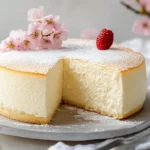
This fluffy Japanese cotton cheesecake is light as air, rich as cheesecake, and uses simple pantry ingredients. No water bath needed—just a steamy oven technique for a perfectly jiggly, cloud-like texture.
- Prep Time: 30 minutes
- Cook Time: 55 minutes
- Total Time: 1 hour 25 minutes (plus 4 hours chilling)
- Yield: 8 servings 1x
- Category: Dessert
- Cuisine: Japanese
Ingredients
Scale
- 8 oz (226 g) cream cheese, softened to room temperature
- 3 tbsp (42 g) unsalted butter, softened
- 1/2 cup (120 ml) whole milk
- 6 large eggs, separated into yolks and whites
- 1/4 cup (30 g) all-purpose flour
- 1 tbsp (8 g) cornstarch
- 1/2 cup (100 g) granulated sugar
- 1 tsp vanilla extract
- 1 tbsp fresh lemon juice
- 1/4 tsp salt
- Butter or non-stick spray for greasing
- Parchment paper
Instructions
- Preheat your oven to 325°F (165°C). Place a rack in the middle position and another rack on the very bottom. Put your roasting pan or baking dish on the bottom rack. Boil about 2 cups of water in a kettle or pot—you’ll add it to the pan right before the cake goes in.
- Prepare your cake pan. Grease the inside of an 8-inch round cake pan with butter or non-stick spray. Cut a circle of parchment paper for the bottom and a long strip for the sides. Press the parchment into place. The sides should come up about 2 inches above the rim of the pan—this helps the cake rise tall without spilling over.
- Melt the cream cheese mixture. In a large heatproof bowl, combine the softened cream cheese, butter, and milk. Set the bowl over a pot of simmering water (double boiler style) and stir gently until everything is melted and smooth. You can also microwave this in 20-second bursts, stirring between each, until smooth. Let it cool slightly—about 5 minutes.
- Add the egg yolks and dry ingredients. Whisk the egg yolks into the cream cheese mixture one at a time, mixing well after each. Then sift in the flour, cornstarch, and salt. Stir until just combined—don’t overmix. Add the vanilla extract and lemon juice, and give it one final stir. Set this mixture aside.
- Whip the egg whites. In a completely clean, dry bowl, beat the egg whites on medium speed until they become frothy and bubbly. Gradually add the sugar, about a tablespoon at a time, while continuing to beat. Increase the speed to high and whip until stiff peaks form. You’ll know it’s ready when you lift the beaters and the meringue stands up in firm peaks that don’t droop. This takes about 4-5 minutes with a hand mixer. Don’t overwhip—if the meringue looks grainy or separates, you’ve gone too fa…
- Fold the meringue into the batter. Take about one-third of the meringue and stir it into the cream cheese mixture to lighten it. This step is important—it makes folding the rest easier. Then gently fold in the remaining meringue using a rubber spatula. Use a cutting motion down through the center, then sweep up along the side of the bowl. Rotate the bowl as you go. Fold just until no white streaks remain. Be gentle—you want to keep as much air in the batter as possible.
- Pour the batter into the pan. Gently pour the batter into your prepared pan. Tap the pan on the counter a few times to release any large air bubbles. Don’t overdo it—you don’t want to deflate the batter.
- Create the steam bath. Carefully pour the hot water from your kettle into the roasting pan on the bottom oven rack. The water should be about 1 inch deep. Place the cake pan on the middle rack, directly above the water. Close the oven door quickly to trap the steam.
- Bake. Bake at 325°F (165°C) for 15 minutes. Then reduce the oven temperature to 300°F (150°C) without opening the door. Bake for another 40-45 minutes. The cake should be golden on top and slightly jiggly in the center when you gently shake the pan. A toothpick inserted in the center should come out clean or with just a few moist crumbs. If the top is browning too quickly, tent it loosely with foil after 30 minutes.
- Cool in the oven. This is the secret step that prevents cracking. Turn off the oven and crack the door open slightly (use a wooden spoon handle to prop it open). Let the cake sit in the warm oven for 15 minutes. This gradual cooling helps the cake settle without collapsing.
- Remove and cool completely. Take the cake out of the oven and let it cool in the pan on a wire rack for 10 minutes. Then run a knife around the edges and carefully lift the cake out using the parchment paper. Peel off the parchment and let the cake cool completely on the rack—about 1 hour.
- Chill before serving. For the best texture, wrap the cooled cake in plastic wrap and refrigerate for at least 4 hours, or overnight. Chilling firms up the texture and makes it easier to slice. The cake actually tastes even better the next day, when the flavors have had time to meld.
Notes
Room temperature ingredients are non-negotiable. Don’t skip the lemon juice—it stabilizes the meringue. Fold gently to keep air in the batter. Watch the oven temperature and don’t open the door during baking. Let the cake cool slowly in the oven to prevent cracking.
Nutrition
- Serving Size: 1 slice
- Calories: 285
- Sugar: 18
- Sodium: 220
- Fat: 18
- Saturated Fat: 10
- Carbohydrates: 24
- Protein: 7
Keywords: Japanese cotton cheesecake, fluffy cheesecake, jiggly cheesecake, easy cheesecake recipe, homemade cheesecake, light cheesecake, cloud cheesecake